
Great Loop Route Overview
A common phrase among Loopers is “no two Loops are the same” and that’s not only because everyone’s experiences are different! The Great Loop route consists of both natural and man-made waterways, and often there are multiple ways to arrive at the same destination.
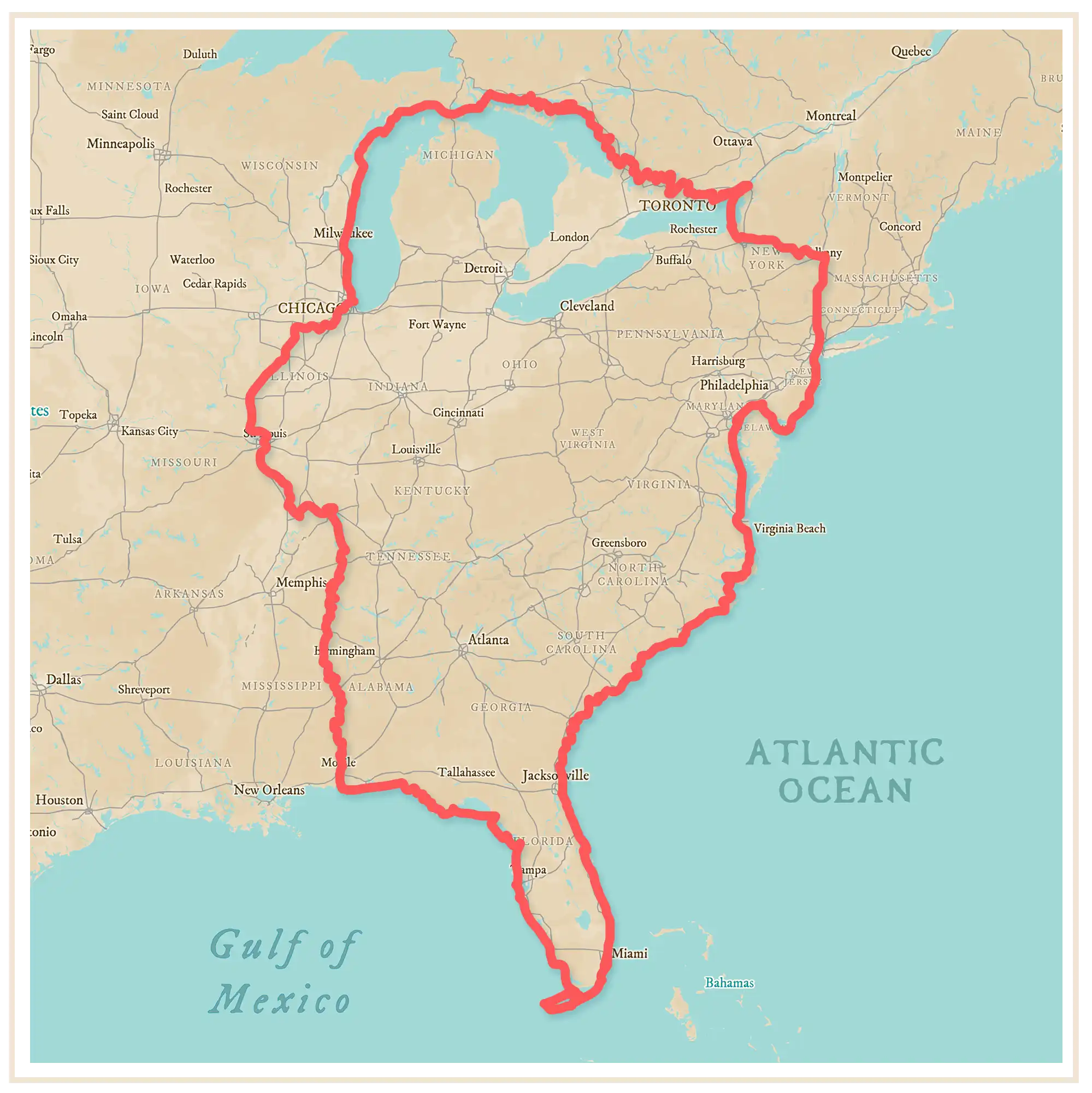
A Great Loop journey has no set starting point, and is concluded when you “cross your wake” at the location where you began. An average Loop is ~6,000 miles, but can easily be longer or shorter depending on the specific route you choose to cruise. The route can be split into six sections:
- The Gulf Coast
- Atlantic ICW
- C&D Bays
- New Jersey & New York
- The Great Lakes
- Inland Waterways

The Gulf Coast
— 750 miles
The Gulf Coast route on the Great Loop primarily follows Florida’s west coast, known as the “Nature Coast.” Florida’s panhandle glitters with white sandy beaches, giving way to marshes and warm shallow waters as you round the Big Bend. The Gulf Coast waterways include:
- Gulf Intracoastal Waterway (GICW / GIWW)
- Big Bend of Florida
- Gulf of Mexico

Atlantic Intracoastal Waterway
— 1,250 Miles
The southernmost point of the continental U.S. is Key West, Florida. For Loopers, this also begins their journey up the 1,250-mile Altantic Intracoastal Waterway (AICW / AIWW). The Atlantic ICW follows natural ad man-made waterways through Florida, Georgia, South Carolina, North Carolina and into Virginia until it reaches the mouth of the Chesapeake Bay at Norfolk, Virginia.

Chesapeake & Delaware Bays
— 275 miles
The Chesapeake Bay and Delaware Bay are connected by the man-made C&D Canal. Both bays are large bodies of water, requiring excellent weather windows for travel. Chesapeake & Delaware Bay waterways:
- Chesapeake Bay
- C&D Canal
- Delaware Bay

New Jersey & New York
— 500 miles
Loopers leave the Delaware Bay at Cape May, New Jersey. From this point, Loopers can cruise to the New York Harbor via the New Jersey ICW or out in the open ocean. After reaching New York, Loopers will travel the Hudson River to the eastern Erie Canal, before making their way to Lake Ontario.
- New Jersey ICW
- Atlantic Ocean
- New York Harbor
- Hudson River
- Erie Canal
- Oswego Canal

The Great Lakes
— 1,200 miles
The Great Lakes hold over 20% of the entire world’s fresh water! Most Loopers will only cruise three out of the five Great Lakes, before entering the inland waterways around Labor Day.
- Lake Ontario
- St. Lawrence River
- Trent-Severn Waterway
- Lake Huron
- Lake Michigan

Inland Waterways
— 1,400 miles
The inland waterways stretch from Chicago, Illinois to Mobile, Alabama. The mostly southern-flowing rivers are controlled by series of locks and dams. Watch the beauty of the Fall colors, and travel the incredible vein that moves a nation by water.
- Chicago Sanitary and Ship Canal
- Des Plaines River
- Illinois River
- Mississippi River
- Tennessee River
- Tenn-Tom Waterway
- Tombigbee River
- Mobile River
- Mobile Bay